

How To Use Fold Over Elastic
Have you heard about fold over elastic? Ever wondered what this product is, where it can be used and how to apply fold over elastic?
You’re in the right place! In this product guide we’re going to shine a light on all things fold over elastic so grab a cuppa and read on!

- What Is Fold Over Elastic
- What Is Fold Over Elastic Used for?
- How to Sew Fold Over Elastic
What is Fold Over Elastic?
Fold Over Elastic (or ‘FOE’ for short) is a thin, lightweight, flat elastic which has a crease down the centre of its length. The crease makes it easy to fold in half along the length, encasing the seam edge of your pattern piece.

Fold Over Elastic comes in a wide variety of colours & patterns – we have a great selection of printed options and almost every colour you can imagine!
Boring Legal Bit: If you follow any tutorial or guidance found in this post, or on this blog, you agree to be bound by our disclaimer which can be viewed here
What is Fold Over Elastic Used for?
Anywhere you need a stretchy binding in a funky colour or print really!
Some popular project ideas for fold over elastic are:
- Legs, waistbands and armholes on lingerie, underwear & swimwear
- Edge finishes on shorts, vests and other undergarments
- Edge finishes on sportswear/activewear
- Cloth nappies
- Edge finishes on expandable pouches and pockets on bags.
- Simple knotted hair ties
- Headbands
- Face Masks
It can be a nice way to add contrast accents or fun prints to your underwear, sportswear or knit/jersey fabric projects, whilst finishing the raw edges of your seams easily.
It is usually used to finish armholes, leg holes, waistbands and necklines on garments that need a lot of recovery, and that stretch to stay close to the body with movement, like underwear and other undergarments like vests, tights and leggings.
Fold over elastic can also be useful in bag making a lot in bag making too for pockets that would benefit from being taut to the bag like these

From Lovelucie.org

from Treasurie.com


Fold Over Elastic can be sewn on a regular sewing machine, so no need to be wrestling with an overlocker or any fancy feet or accessories!
Fold Over Elastic has a similar function to bias binding as it completely finishes a raw edge, but fold over elastic can stretch & recover so it keeps the edge close to the body, or it provides a taut edge for pockets on bags etc.
Usually, the narrower the Fold Over Elastic, the more stretch it has, and the wider it is, the less it stretches. You can usually interchange different widths of Fold Over Elastic in your projects, but make sure you double-check you have the right length as differences in stretch means you will require different lengths, and account for the width in your seam allowances.
Preparing and Cutting Fold Over Elastic
Many patterns will call for you to cut your elastic to a specific length, but if no instructions are given, there is an easy way to figure out what length to cut your fold over elastic (or any elastic!) to.
- Begin by measuring the lengths of the leg openings, waistband, or other pattern piece you are applying the elastic to.
- Check the stretch of your elastic, if it’s really stretchy, you can get away with the elastic being a little shorter. If it’s quite hard to stretch, you will need the elastic to be a little longer.
- The general rule is that elastic must be shorter than the length of the edge to which it is being applied to. Deduct 10% from the length of the edge, and this will give you your elastic length. You can also adjust this percentage up or down depending on the stretchiness of your elastic.
e.g : 50cm is the length of the leg opening. 50-5cm =45cm.
45cm is the length of your elastic.
Adjusting your pattern to use Fold Over Elastic
Using Fold Over Elastic on the edge of your garment means that the edge is finished and enclosed at the width it is cut, so no fabric is removed due to a seam allowance, or folding under and hemming. If you want to use Fold Over Elastic on a project that requires a different finish (like regular elastic or picot trim elastic types), you will need to trim away the excess fabric before using the Elastic. Simply take your pattern piece and trim off the seam allowance width on the edges you want to apply the elastic to.
If your pattern needs you to use Fold Over Elastic but you don’t have any to hand, and want to use a different finish on the edge, add the seam allowance or hem desired to the edges where the elastic or your other trim will be applied.
Never miss a guide or tutorial
Click to join our mailing list!
Sewing and Handling Tips for Fold Over Elastic
- Needle – A jersey, stretch or ballpoint needle are the best choices, as these needles slide between the fibres rather than piercing them. You might be ok with a universal needle if that’s all you have – just make sure you test first.
- Thread – Try to match the thread you use with the fibre that makes up the elastic. For most types of Fold Over Elastic a strong, polyester thread would work best, and would also help create strong stitches for any stretch or stress on the item you make. All-purpose Polyester thread is a good choice.
- Stitch Type – Use either a medium zig zag or a 3 step zig-zag stitch. Set your machine to 2 wide with a stitch length of 2.5 to start then test. This is a good setting to start but stitch lengths/ widths will vary from project to project, so test first to see what works for you.
- Sewing – Stretch the elastic a little when sewing to evenly distribute across the unfinished edge.
- Sewing – Try to keep a slow steady pace whilst sewing, and avoid pulling the elastic or the fabric through the machine more than you need to. This will help you avoid gathers or puckers as you won’t stretch the fabric whilst sewing.
- Sewing – Sew a sample swatch using a square of your final fabric and a length of Fold Over Elastic to help achieve the best tension. Playing around on your machine with a sample means you won’t spend time unpicking your final project if the tension is off. The best tension will vary significantly between different fabrics and elastics, even of the same composition or type.
Have you read our Ultimate Guide To Sewing Needles post yet?
How to Sew Fold Over Elastic
Method 1 : The 2-step method
This method is perfect for beginners as it secures the elastic and fabric in place before fully attaching the Fold Over Elastic. This means there is less chance of the elastic or fabric slipping out of place.
The disadvantage of this method however, is that you can see the initial line of stitching from the wrong side of the garment once complete.
- Place your fabric WS (wrong sides) together with your Fold Over Elastic and line up the raw edge of your fabric with the centre crease line. Pin in place. To prevent gathering, it is best to have a few cm of elastic overhanging at each end to cleanly feed the fabric layers through the machine.

2. Stitch in place, using a narrow zig-zag stitch length and width of 2mm. If you would rather use a three-step zig-zag, use a width of 3.5 mm to 4 mm and a length of 1 mm to 1.5 mm. – you may want to adjust this based on your individual machine tension, fabric composition and elastic.
This stitch line will only be visible from the wrong side of your finished garment, but secures the elastic in place on the back side of the fabric.

- Carefully trim away the excess fabric in the seam allowance.
- Fold over the top section of the Fold Over Elastic, pin in place.

- Stitch in place using a zig zag stitch.

Follow Us on Instagram!
Method 2 : The 1-step method
This method creates the perfect enclosed edge, with a single line of stitching so it’s neater BUT it requires a little more patience and more pins.
- Place your fabric WS (wrong sides) together with your Fold Over Elastic.
Line up the raw edge of your fabric with the centre crease line. Pin in place.
To prevent gathering, it is best to have a few cm of elastic overhanging at each end to cleanly feed the fabric layers through the machine.
2. Fold over the top section of the Fold Over Elastic, pin in place, sandwiching the fabric in between the two layers of Fold Over Elastic.

- Stitch in place, using a narrow zig-zag stitch length and width of 2mm. If you would rather use a three-step zig-zag, use a width of 3.5 mm to 4 mm and a length of 1 mm to 1.5 mm. – you may want to adjust this based on your individual machine tension, fabric composition and elastic.

Method 3: The 1 step method (with a little help!)
This is the same method as above, but with a little additional help that does not show on the final garment.
- Apply an adhesive, such as Quilters Tape, Wundaweb or a regular glue pen (do not use runny glue or PVA) along the edge of the WS of the fabric. If the adhesive is wider than you FOE you can just trim it (or clean your iron after if you get in to trouble here!)
- Place your fabric WS (wrong sides) together with your Fold Over Elastic & line up the raw edge of your fabric with the centre crease line. Press in place so the adhesive sticks to the back of the fabric and the Fold Over Elastic. Pin in place. To prevent gathering, it is best to have a few cm of elastic overhanging at each end to cleanly feed the fabric layers through the machine.
- Fold over the top section of the Fold Over Elastic, pin in place, sandwiching the fabric in between the two layers of Fold Over Elastic.
- Stitch in place, using a narrow zig-zag stitch length and width of 2mm. If you would rather use a three-step zig-zag, use a width of 3.5 mm to 4 mm and a length of 1 mm to 1.5 mm. – you may want to adjust this based on your individual machine tension, fabric composition and elastic.
Don’t worry about the garment edge being stiff, as both of these adhesives will dissolve after the first wash.
Method 4: The 2 step method (with removable basting stitch)
This is the same method as method 1, but with a basting stitch that can be removed easily.
- Place your fabric WS (wrong sides) together with your Fold Over Elastic and line up the raw edge of your fabric with the centre crease line. Pin in place if required. Hand stitch/baste in place by hand, using long, fairly loose stitches. Only secure with a knot at one end – this allows for easier removal.


2. Fold over the top section of the Fold Over Elastic, pin in place, sandwiching the fabric in between the two layers of Fold Over Elastic.


3. Stitch in place, using a narrow zig-zag stitch length and width of 2mm. If you would rather use a three-step zig-zag, use a width of 3.5 mm to 4 mm and a length of 1 mm to 1.5 mm. – you may want to adjust this based on your individual machine tension, fabric composition and elastic.
4. Flip over the elastic, and gently pull the basting stitch out of the fabric and elastic. If it is stuck, gently use a seam ripper or small pair of scissors to remove it.
Sewing Fold Over Elastic in the round
Sometimes you won’t be able to apply the Fold Over Elastic to a flat edge, where the seam is sewn after to join the two pieces. You will need to apply the Fold Over Elastic in the round on some patterns, on armholes, necklines and even some waistlines.
To do this, you need to sew together the ends of the Fold Over Elastic before you apply it to your garment.
There are two main methods;
Method 1 – the straight join
Simply sew across the ends of the Fold Over Elastic, once cut to the desired length, then pin and sew it to the rounded edge. You can use any of the above methods to apply it in one or two steps, but we recommend trimming away the excess fabric if using the two step method.
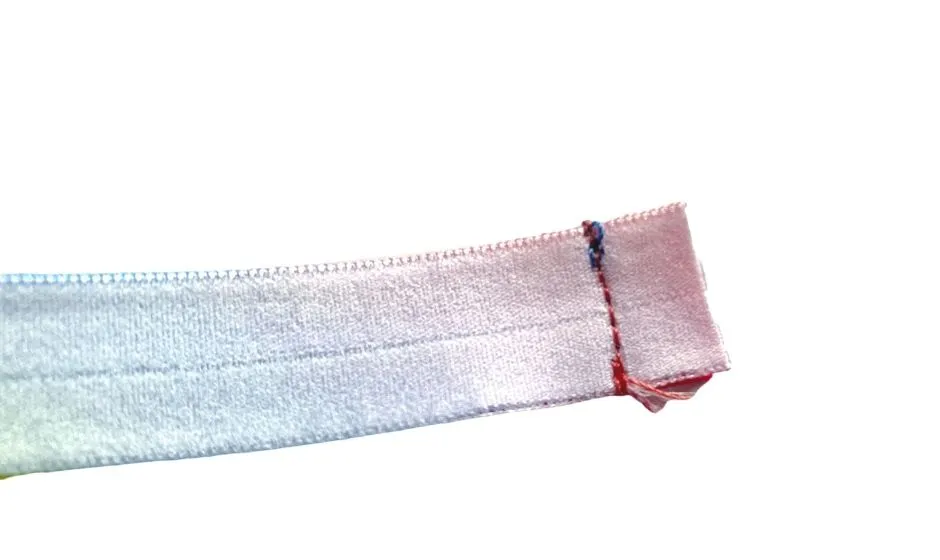

Method 2 – the mitred join
A mitred or bias join is where the two ends of the Fold Over Elastic cross at a 90 degree angle instead of aligning as above. This allows you to ease the Fold Over Elastic into the round a little easier as there is ease on the bias as well as the stretch. You cross over the ends of the Fold Over Elastic at a 90 degree angle, then sew from point to point where the top end crosses the bottom end. Trim excess bulk from the seam and then apply as above.


We hope you found this product guide helpful. Drop us a message with any comments or questions you have!
Never miss a guide or tutorial
Click to join our mailing list!

How To Use Waistband Extenders – No Sew! Care & Repair Series #2
Welcome to post number 2 in our Care & Repair Series! Today we’re offering a solution to a common problem – how to really quickly and easily extend a waistband… without any sewing! We’ll highlight this little wonder product and run you through why you might need them and how to use these waistband extenders.
Let’s be real. The pandemic has meant that many of us have put on some extra pounds and clothes might have become a little snug!
Or perhaps you’re in the early stages of pregnancy and could do with an extra bit of room before buying some maternity clothes?
And let’s not forget – some days we’re just bigger than others… This can be due to our monthly cycles, or perhaps eating certain foods can make you bloat.
You might need some extra comfort post-surgery, or just after a jolly good meal! Or perhaps something has shrunk in the wash (that old chestnut…!)
Our bodies can even fluctuate in size from day to day so a quick temporary fix can help ease discomfort.
We wanted to bring this little wonder products to your attention – who knew they were even a thing?!
And as these nifty little extenders are a NO SEW temporary fix it means they can even be switched between garments to extend their life.

With this series of Care & Repair blogs we really want to bring into focus ways in which we can all reuse, repurpose, repair and rejuvenate the clothes that are already in our wardrobes.
300,000 tonnes of discarded clothing goes to landfill every year in the UK, making up 5% of the UK’s carbon and water footprint, according to Wrap, the waste charity. There’s never been a more important tome to make do and mend.
Being able to easily adjust the size of waistbands can help give them an extra lease of life and also improve their comfort by adding a little extra room. The wasit band extenders generally give you and extra will extend the waistline by approximately 2.5cm- 5cm on your waist band and are suitable for trousers, jeans or skirts.
No need to replace perfectly good garments that haven’t worn out; this is better for our wallets and for the planet – win win!
Extenders are not permanent fixtures to your garments so they can easily be switched out as required. Just make sure you remove them before laundering!
The waist extenders come in a variety of options…. make sure you select the best match for your garment.
You can also link multiple extenders together to achieve the level of fit you require – read to the end of this post to see this in action…
How to use waist band extenders
- Select the Waist Band Extender product which best matches the fastening and colour of your garment. There are button, hooks and jean button products to choose from
Waistband Expander
2. Thread the existing fastening through one of the holes on the extender piece
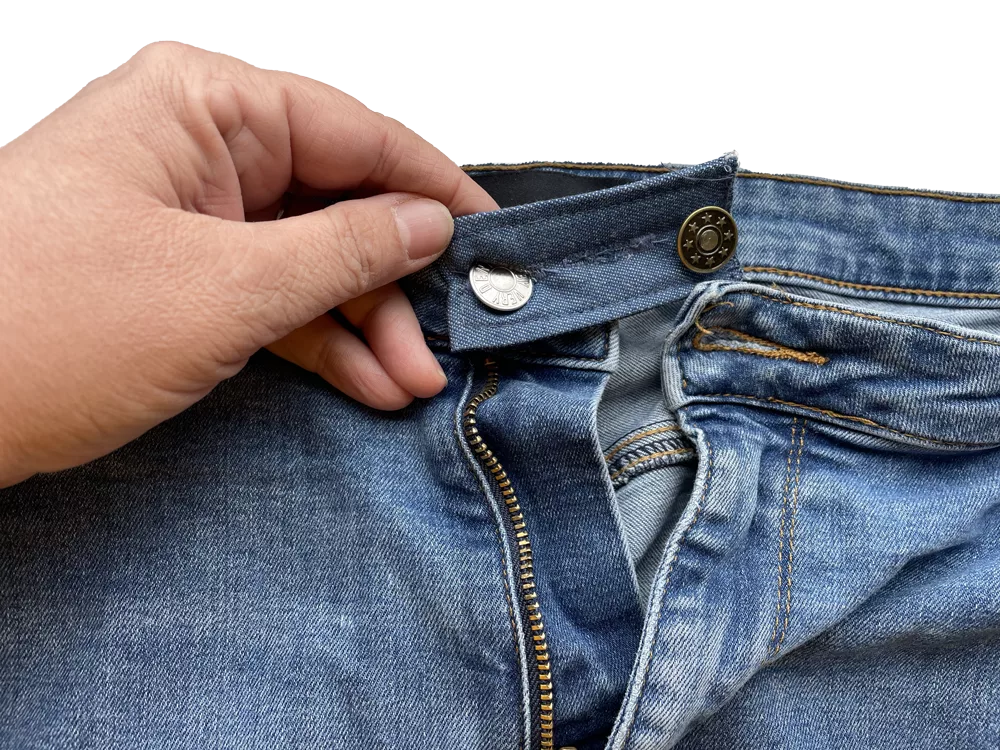
3. Thread the fastening on the extender through the garment hole
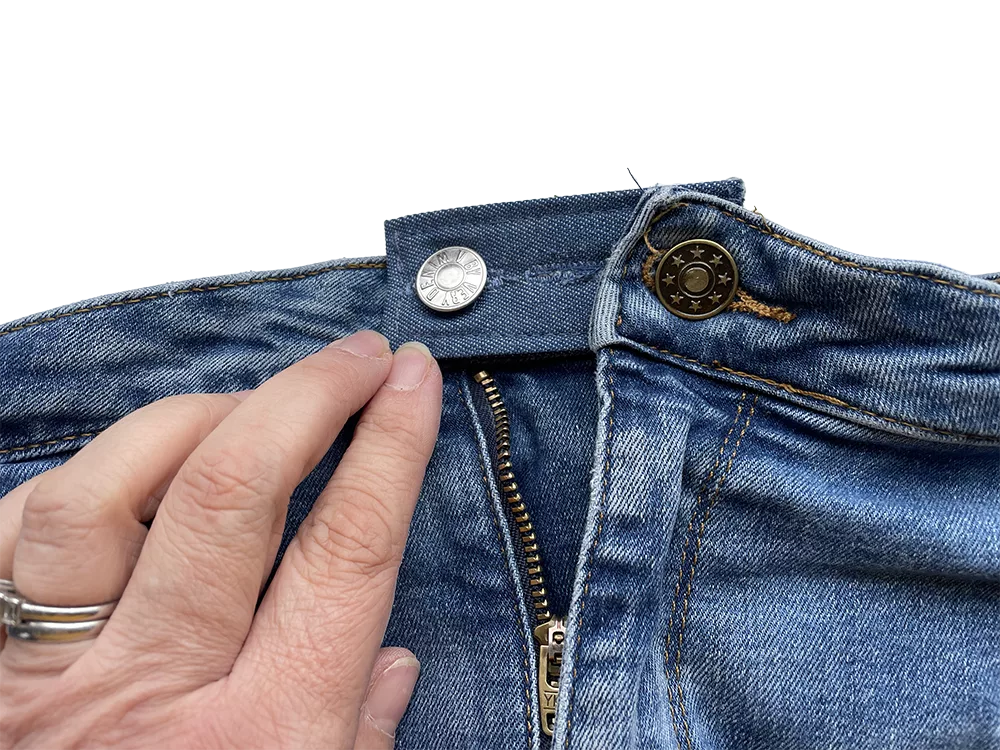
Voila! Extra comfort at the waist in a jiffy!
Check out Hemline’s video here to see how the hook product works
Never miss a guide or tutorial
Click to join our mailing list!
Linking Waistband Extenders Together
Should you need even greater ease at the waistband, the extenders can be looped together to create a larger stretch like this.
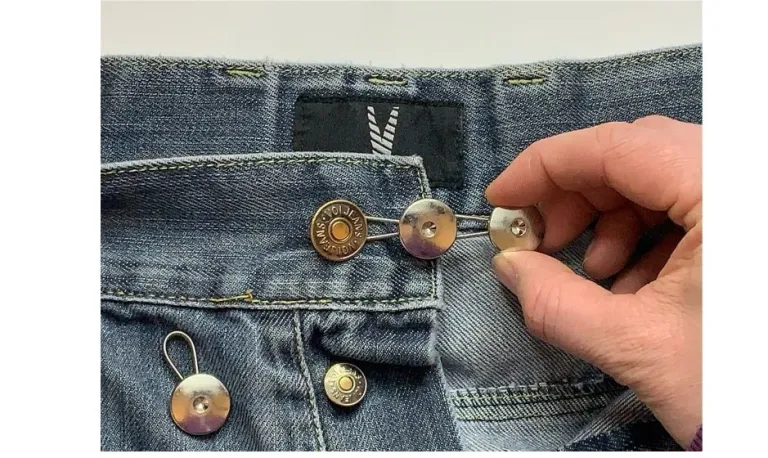
See how easy it is to prolong the life of your garment if it’s become a bit snug!